Published · journal article
ASAP for multi-outputs: auto-generating storyboard and pre-visualization with virtual actors based on screenplay
2025 · Multimedia Tools and Applications · First online 3 August 2024; volume 84 (2025)
Equal contribution
A screenplay becomes storyboards, animated previsualization, and immersive scenes.

From the paper
Author abstract
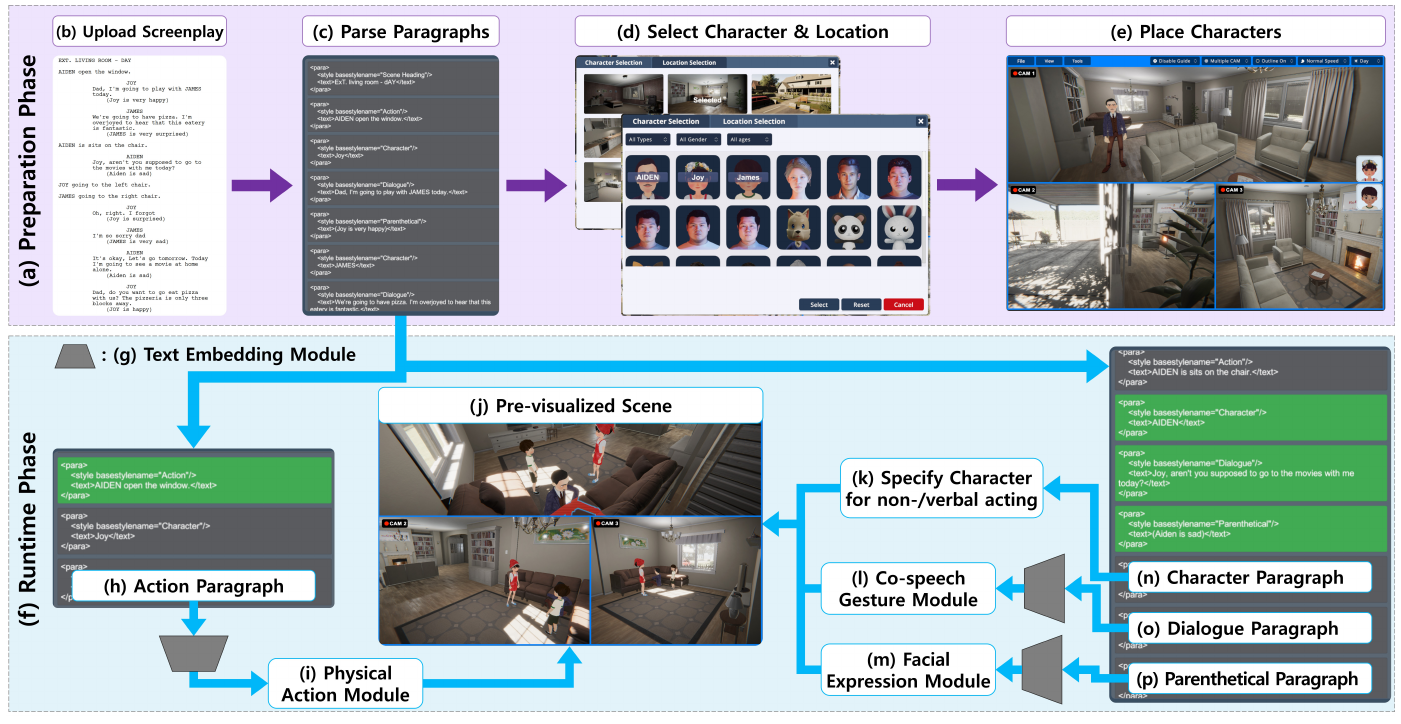
One of the pressing desires of content creators is to be able to visualize how their characters will look in a scene as soon as possible. In the early stages of film production, this desire can be partly achieved by the computer graphics-based process known as Pre-visualization (Previz). However, traditional previz necessitates a high level of expertise and is also time-consuming. This paper introduces the ASAP system, an automated tool that creates pre-visualized animations and storyboards by generating virtual character behavior/animations based on understanding the screenplay. The ASAP system parses the user-written screenplay to extract data, including character names, dialogue, actions, and emotions. This extracted data is then passed to the respective modules, which select virtual characters and automatically generate their speaking gestures, physical movements, and expressive behaviors. We demonstrate the system’s fidelity by presenting multiple outputs, including a 2D storyboard, a 3D preview, and a VR-based immersive scenario, along with simulations of potential use cases. The ASAP system can streamline pre-visualization tasks in the pre-production phase and has the potential to be widely adopted by the film industry.
Author-written abstract from the author manuscript.
In plain language
What this work does
ASAP parses screenplay structure into characters, dialogue, actions, and emotions. Its modules select virtual actors and compose speech gestures, physical actions, facial expressions, and scene outputs. The journal expands the earlier ISMAR system and SIGGRAPH Asia live demonstration.
- 01Screenplay
- 02Characters + actions + emotion
- 03Storyboard / 3D / VR
At a glance
Method, evidence, and scope
| Input | A structured screenplay |
|---|---|
| Output | 2D storyboards, animated 3D previews, and immersive VR scenes |
| Method | Screenplay parsing and coordinated character-behavior modules |
| Data and scope | Screenplay examples and action-sentence evaluation described in the paper |
| Evaluation | Reported top-1 action accuracy: 93% on simple sentences and 87% on complex sentences |
| Limitations | Animation coverage and scene composition depend on the available characters, actions, props, and environment assets. |
Watch the system
Related ASAP system: SIGGRAPH Asia 2022 live presentation
Open on YouTube · MRLab video gallery · This video presents the related ASAP system, not this paper’s evaluation.
Implementation and artifacts
Code and setup
Independent implementation of the paper’s core ideas, with setup instructions and data preparation documented in the repository README. The institute’s original source, datasets and trained models are not distributed.
Browse code and setup guideReference this work
Citation
Hanseob Kim, Ghazanfar Ali, Bin Han, Hwang Youn Kim, Jieun Kim, Hyemin Shin, Gerard Jounghyun Kim, Jae-In Hwang. ASAP for multi-outputs: auto-generating storyboard and pre-visualization with virtual actors based on screenplay. Multimedia Tools and Applications, 2025. Volume 84. Issue 20. Pages 22377-22400. DOI: 10.1007/s11042-024-19904-3.
@article{asapjournal2025,
  title = {{ASAP for multi-outputs: auto-generating storyboard and pre-visualization with virtual actors based on screenplay}},
  author = {Kim, Hanseob and Ali, Ghazanfar and Han, Bin and Kim, Hwang Youn and Kim, Jieun and Shin, Hyemin and Kim, Gerard Jounghyun and Hwang, Jae-In},
  year = {2025},
  journal = {Multimedia Tools and Applications},
  volume = {84},
  number = {20},
  pages = {22377-22400},
  doi = {10.1007/s11042-024-19904-3},
  url = {https://ghazanfarali.com/research/asap-journal/}
}