Published · conference paper
Through Van Gogh’s Eyes: Global Style Transfer with Diffusion Model
2026 · ECCV
A broader artist style distribution guides diffusion image synthesis.
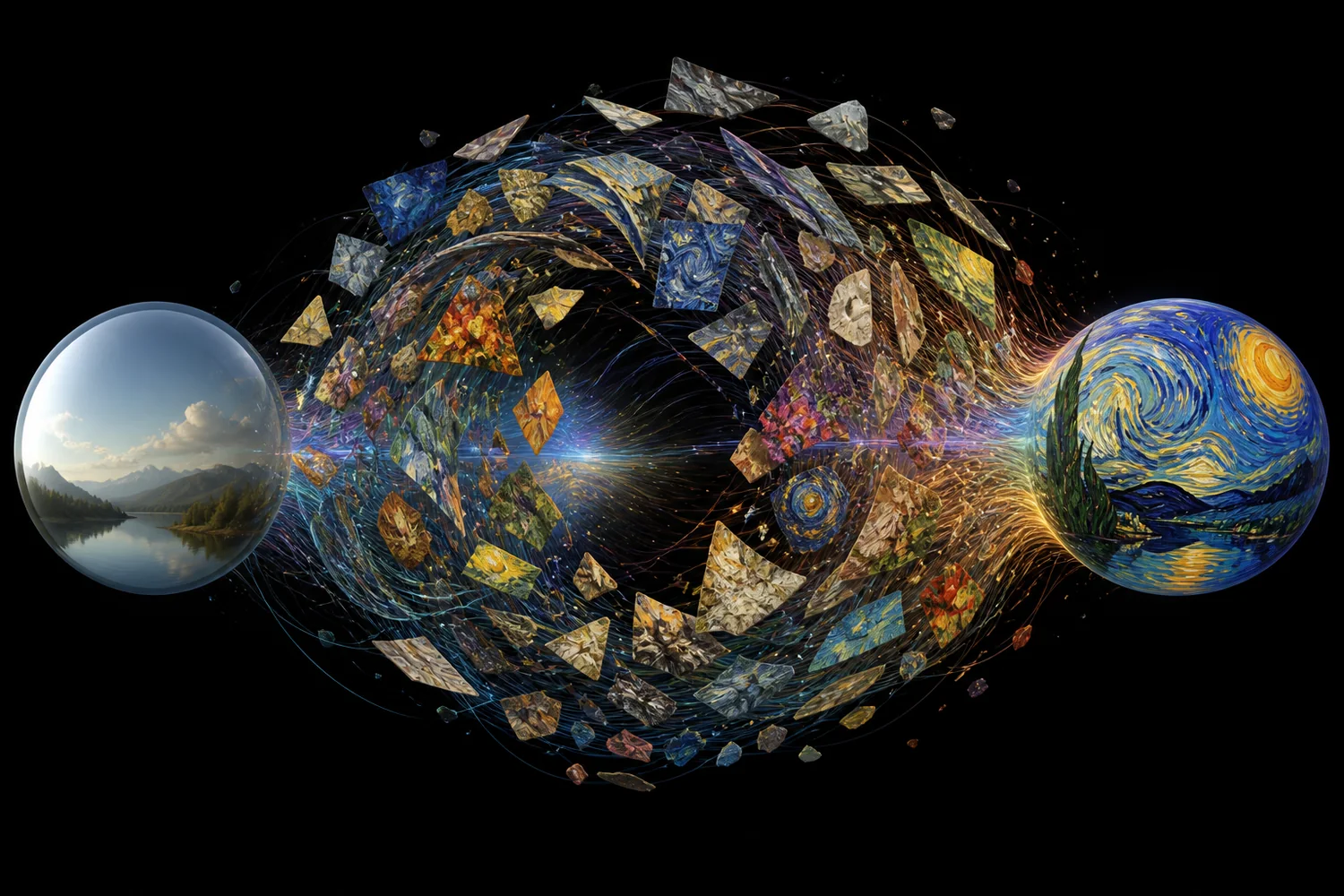
From the paper
Author abstract
Diffusion models have achieved strong performance in artis-006 tic image synthesis, yet they still suffer from stylistic bias: when instruct-007 ing the diffusion model to create ‘Van Gogh-style’ images, we observed008 that the model tends to repeatedly generate textures and compositions009 characteristic of a narrow subset of iconic works. This bias limits the010 model’s ability to fully represent an artist’s stylistic diversity. To ad-011 dress this, we introduce Global Style Transfer (GST), a text-independent012 framework that learns an artist’s unified style distribution by training013 global visual statistics from hundreds of artworks. GST guides the diffu-014 sion process in the intermediate feature space (h-space), enabling gener-015 ation that reflects an artist’s global stylistic spectrum rather than relying016 on prompt-specific cues or memorized exemplars. In addition, we propose017 Content Alignment Guidance (CAG), a training-free guidance that aligns018 the semantic structure of a given content image while permitting flex-019 ible, style-based deformation. CAG preserves content identity without020 constraining artistic variation, allowing structural reinterpretations that021 naturally arise in artistic expression. Experiments on WikiArt bench-022 marks demonstrate that our method produces images with improved023 style consistency, reduced prompt-induced bias, and greater fidelity to024 global artistic semantics compared to the vanilla diffusion model. Our025 findings establish GST as a new direction for bias-robust artistic image026 generation.027
Author-written abstract from the author manuscript.
In plain language
What this work does
Global Style Transfer learns visual characteristics from a collection of an artist’s works rather than relying on one reference painting or a style prompt. Content Alignment Guidance preserves the content image’s semantic structure while allowing artistic deformation.
- 01Content + artist corpus
- 02Style + content guidance
- 03Stylized image
At a glance
Method, evidence, and scope
| Input | Content image and a target artist’s artwork collection |
|---|---|
| Output | An image combining source content with artist-level style |
| Method | Global Style Transfer in diffusion h-space; Content Alignment Guidance |
| Data and scope | WikiArt artwork collections |
| Evaluation | Comparison with vanilla diffusion on style consistency, content alignment, and stylistic bias |
| Limitations | A collection-level style representation does not establish reproduction of an artist’s intent; results depend on the artwork corpus and diffusion model. |
Implementation and artifacts
Code availability
The original implementation is held by the institute. A separate public educational implementation is planned. No repository or trained weights are linked from this page yet.
Reference this work
Citation
Jeongha Lee, Yujin Kim, Ghazanfar Ali, Suhyun Kim, Jae-In Hwang. Through Van Gogh’s Eyes: Global Style Transfer with Diffusion Model. ECCV, 2026. Pages 571-588. DOI: 10.1007/978-3-032-37092-1_32.
@inproceedings{globalstyletransfer2026,
  title = {{Through Van Gogh’s Eyes: Global Style Transfer with Diffusion Model}},
  author = {Lee, Jeongha and Kim, Yujin and Ali, Ghazanfar and Kim, Suhyun and Hwang, Jae-In},
  year = {2026},
  booktitle = {ECCV},
  pages = {571-588},
  doi = {10.1007/978-3-032-37092-1_32},
  url = {https://ghazanfarali.com/research/global-style-transfer/}
}