Published · adjunct paper
LUFA: Lightweight Upper-Face Animation for VR/MR Avatars
2025 · IEEE ISMAR-Adjunct
Lightweight upper-face animation for VR and MR avatars.
From the paper
Author abstract
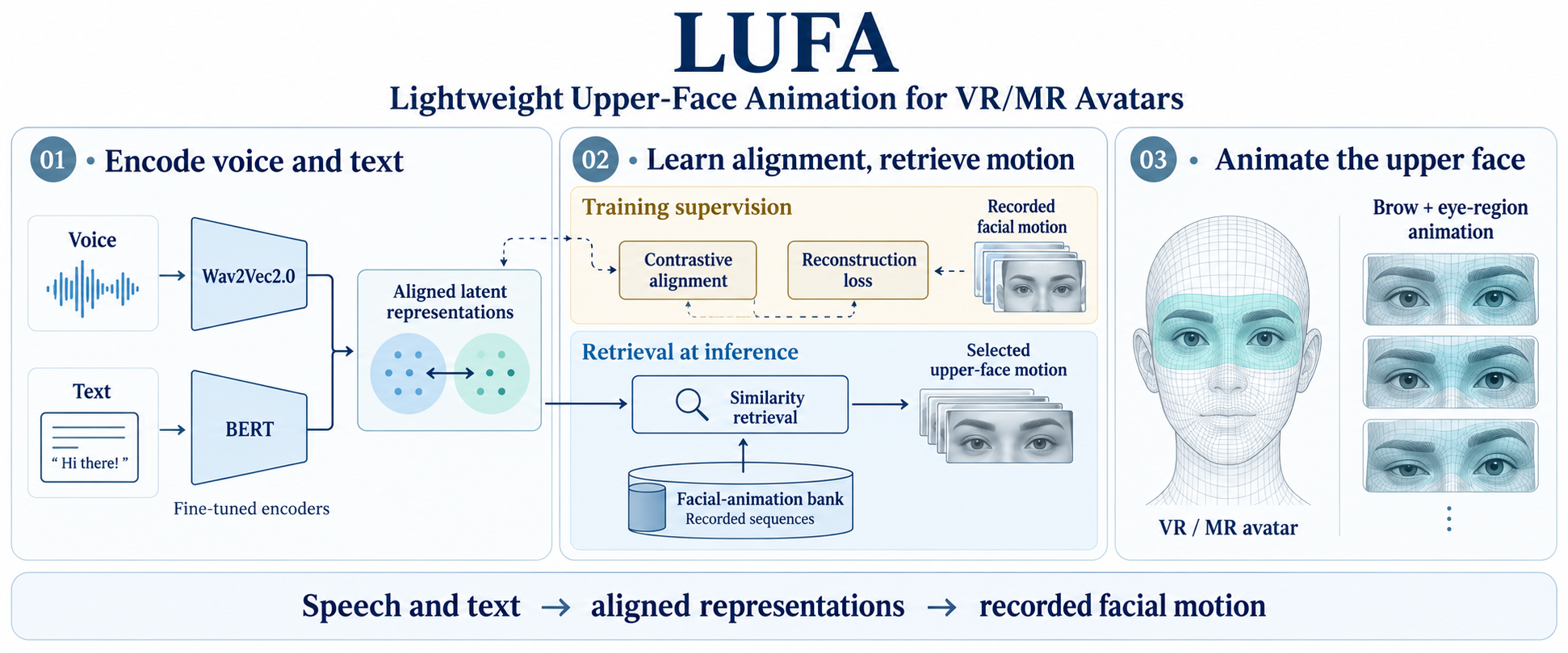
For virtual agents, realistic co-speech facial expressions are essential to enhance naturalness. Rule-based methods lack diversity and temporal consistency in generating emotional expressions. Additionally, generating facial animation using large-scale generative models requires substantial computational resources, making real-time deployment challenging. In this paper, we propose Lightweight Upper-Face Animation for VR/MR Avatars (LUFA), a co-speech facial expression framework for generating real-time animations from voice and text inputs. We fine-tune Wav2Vec2.0 and BERT encoders using a reconstruction loss. Our framework treats their outputs as latent representations, aligns them through contrastive learning, and retrieves facial animation sequences based on these representations.
Author-written abstract · Source record
In plain language
What this work does
LUFA encodes voice and text with fine-tuned Wav2Vec2.0 and BERT models. Reconstruction loss and contrastive learning align latent representations, which are used to retrieve facial-animation sequences for VR and MR avatars. The related journal manuscript studies a later emotion–liveness approach and is in final review.
- 01Voice + text
- 02Aligned latent representations
- 03Facial animation retrieval
At a glance
Method, evidence, and scope
| Input | Voice and text |
|---|---|
| Output | Retrieved upper-face facial-animation sequences |
| Method | Wav2Vec2.0 and BERT encoders; reconstruction loss; contrastive latent alignment and retrieval |
| Data and scope | Conference abstract describes the representation and retrieval framework |
| Evaluation | Consult the full conference paper for evaluation details |
| Limitations | Retrieval selects existing animation sequences. The later emotion–liveness manuscript’s parameter counts and study results do not describe LUFA. |
Implementation and artifacts
Code and setup
Independent implementation of the paper’s core ideas, with setup instructions and data preparation documented in the repository README. The institute’s original source, datasets and trained models are not distributed.
Browse code and setup guideReference this work
Citation
Hwang Youn Kim, Ghazanfar Ali, Jae-In Hwang. LUFA: Lightweight Upper-Face Animation for VR/MR Avatars. IEEE ISMAR-Adjunct, 2025. Pages 841-842. DOI: 10.1109/ismar-adjunct68609.2025.00217.
@inproceedings{lufa2025,
  title = {{LUFA: Lightweight Upper-Face Animation for VR/MR Avatars}},
  author = {Kim, Hwang Youn and Ali, Ghazanfar and Hwang, Jae-In},
  year = {2025},
  booktitle = {IEEE ISMAR-Adjunct},
  pages = {841-842},
  doi = {10.1109/ismar-adjunct68609.2025.00217},
  url = {https://ghazanfarali.com/research/lufa/}
}