Published · workshop paper
Auto-generating Virtual Human Behavior by Understanding User Contexts
2021 · IEEE VR Abstracts and Workshops
Natural-language context activates grounded virtual-human actions.

From the paper
Author abstract
Virtual humans are most natural and effective when it can act out and animate verbal/gestural actions. One popular method to realize this is to infer the actions from predefined phrases. This research aims to provide a more flexible method to activate various behaviors straight from natural conversations. Our approach uses BERT as the backbone for natural language understanding and, on top of it, a jointly learned sentence classifier (SC) and entity classifier (EC). The SC classifies the input into conversation or action, and EC extracts the entities for the action. The pilot study has shown promising results with high perceived naturalness and positive experiences.
Author-written abstract from the author manuscript.
In plain language
What this work does
A BERT-based model jointly classifies whether a sentence requests conversation or action and extracts action entities. An interaction module turns those predictions into virtual-human behaviors in a controlled room scenario.
- 01Natural-language input
- 02Sentence + entity classifier
- 03Grounded room behavior
At a glance
Method, evidence, and scope
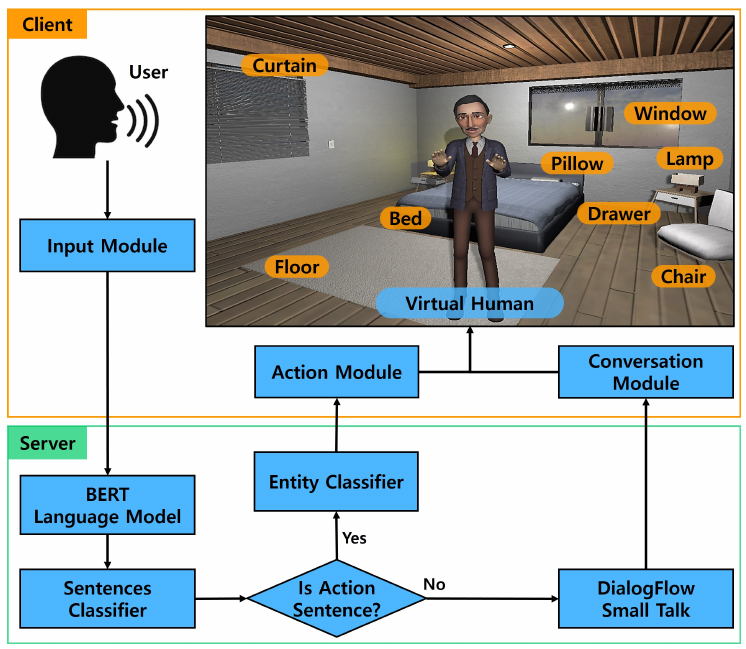
| Input | Natural-language conversation and action requests |
|---|---|
| Output | Action intent, extracted entities, and virtual-human behavior |
| Method | Joint sentence classification and entity classification |
| Data and scope | Controlled room scenario with a fixed object and interaction set |
| Evaluation | Pilot study of perceived naturalness and user experience |
| Limitations | The controlled object and action inventory limits generalization to arbitrary environments. |
Implementation and artifacts
Code and setup
Independent implementation of the paper’s core ideas, with setup instructions and data preparation documented in the repository README. The institute’s original source, datasets and trained models are not distributed.
Browse code and setup guideReference this work
Citation
Hanseob Kim, Ghazanfar Ali, Seungwon Kim, Gerard J. Kim, Jae-In Hwang. Auto-generating Virtual Human Behavior by Understanding User Contexts. IEEE VR Abstracts and Workshops, 2021. Pages 591-592. DOI: 10.1109/vrw52623.2021.00178.
@inproceedings{contextawarebehavior2021,
  title = {{Auto-generating Virtual Human Behavior by Understanding User Contexts}},
  author = {Kim, Hanseob and Ali, Ghazanfar and Kim, Seungwon and Kim, Gerard J. and Hwang, Jae-In},
  year = {2021},
  booktitle = {IEEE VR Abstracts and Workshops},
  pages = {591-592},
  doi = {10.1109/vrw52623.2021.00178},
  url = {https://ghazanfarali.com/research/context-aware-behavior/}
}